



A manufacturer we worked with recently had translated their IFU into what they believed were all the required European languages. Their translation programme was well-managed, their documentation was thorough, and their regulatory team was experienced. They discovered at distribution stage that their Portuguese documentation was Brazilian Portuguese – and that their Belgian launch required Dutch as well as French.
Neither error was born of carelessness. Both came from assumptions that seemed entirely reasonable until they weren’t.
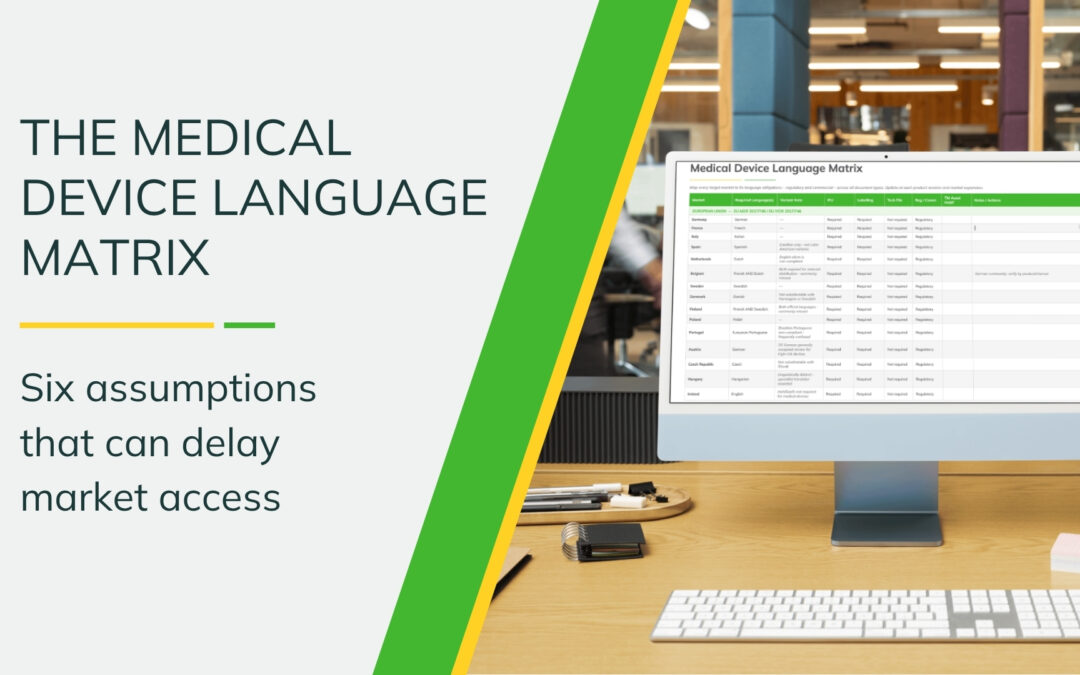
The language matrix – the document that maps every target market to its specific language obligations – sounds like a straightforward exercise. In practice, it’s where a handful of persistent misconceptions consistently create delays, compliance gaps, and unexpected costs. This post covers the six we see most often.
At the end, you’ll find a link to download our free language matrix template: a ready-to-edit Word document pre-populated with EU, UK, Swiss, Norwegian, and key global market requirements, variant notes, and a Translation Memory tracking column – structured to work as a live planning document across your product portfolio, not just a one-time compliance exercise.
Why the Language Matrix Matters More Than It Looks
Under EU MDR and IVDR, the IFU and labelling must be provided in the official language or languages of every EU member state where the device is made available. Straightforward in principle. The complication is that “official language” isn’t a single clean answer for every market, and the matrix has to do more than list languages – it needs to capture language variants, distinguish between regulatory requirements and commercial expectations, map which documents need translating into which languages, and flag the markets that are commonly missed entirely.
Get it wrong at the planning stage, and you’re correcting it under pressure – usually at exactly the point in a product launch when no one has time to deal with it.
Our language expansion calculator helps model the document length consequences once your language list is confirmed. But first, the list has to be right.
The Six Assumptions That Catch Manufacturers Out
1. “Portuguese is Portuguese”
It isn’t – at least not for regulatory purposes. Brazil and Portugal share a language but not a regulatory market, and the differences between European and Brazilian Portuguese extend well beyond accent. Spelling conventions, medical terminology, and the way certain technical concepts are expressed diverge significantly enough that a Brazilian Portuguese translation submitted for the Portuguese market reads as foreign to healthcare professionals and regulators alike.
Manufacturers with existing Latin American programmes are particularly vulnerable to this one. The Brazilian Portuguese asset exists, it passed internal review, and it feels like it should cover Portugal. It doesn’t. Our team specialising in European Portuguese medical device translation works exclusively in the European variant for exactly this reason.
The same distinction applies to Spanish. Castilian Spanish (required in Spain) and Latin American Spanish variants are not interchangeable for regulated documentation, and “Spanish” in a language matrix needs to specify which. Our Spanish medical device translation team can advise on the right variant for each of your target markets.
2. “French covers Belgium”
Belgium has three official language communities – French-speaking, Dutch-speaking, and German-speaking – and manufacturers distributing nationally are required to cover both French and Dutch. The French/Dutch split is consistent and consistently missed.
It’s an easy error to make: France is a large, familiar market; Belgium is often added as an afterthought; and French coverage feels intuitive for a country many associate primarily with Brussels and French-speaking institutions. In translation programme terms, Belgium requires two entirely separate language versions – a French medical device translation and a Dutch medical device translation – not one document that covers both.
Finland has an equivalent: Finnish and Swedish are both official national languages, and medical device documentation is typically required in both. Manufacturers who plan for a single Scandinavian translation discover mid-project that Finland requires two – Finnish medical translation and Swedish medical device translation are distinct workstreams with different translators working on each.
3. “Switzerland is effectively EU”
Switzerland is not an EU member state, and while it has historically operated a mutual recognition agreement with the EU for medical devices, that agreement has been subject to ongoing renegotiation. Swiss market requirements are distinct and need to be planned for explicitly – they are frequently left off the language matrix entirely because Switzerland feels like part of the European regulatory framework.
What Switzerland actually requires is documentation in German, French, and Italian – its three principal national languages. Manufacturers who have produced German medical device translation for the German market sometimes assume it covers Switzerland. It addresses one of the three Swiss requirements; the other two still need planning and budgeting. Norway, similarly, is not an EU member – it implements EU MDR and IVDR as an EEA member and requires Norwegian medical translation separately.
4. “The document that needs translating is the IFU”
The IFU is the most visible requirement, but the language matrix needs to cover the full documentation set – and not everything requires the same language coverage. Labelling, implant cards (a requirement that might catch manufacturers out following the 2026 regulatory updates), EUDAMED registration data, and post-market surveillance reports all carry their own language obligations, which may differ from the IFU requirement.
The more useful question isn’t “which languages does this device need?” but “which documents need which languages in which markets?” A matrix that answers that question is a genuinely useful planning tool. One that only lists languages against countries leaves most of the complexity unresolved. Our IVDR and MDR translation services page covers the regulatory documentation requirements in detail, and our MDR translation compliance checklist is a useful companion when mapping document types from scratch.
For manufacturers navigating the dual UK/EU compliance question post-Brexit, our post on where UK MDR and EU MDR differ in 2026 covers the documentation implications in full.
5. “We can add markets later”
The language matrix is almost always built at the point of translation briefing – when a project is in motion, timelines are fixed, and there’s no budget for surprises. Adding a market at that stage means either delaying launch or commissioning translation under pressure, neither of which is free.
Languages affect more than translation volume. They affect document layout (German expands text by up to 30%; Arabic and Hebrew are right-to-left), packaging dimensions, and production schedules. Building the matrix at product design stage, alongside your regulatory strategy, means these constraints are designed in rather than retrofitted. The language selection guide on our blog covers the strategic decision-making behind market prioritisation, and our medical device IFU translation team works with manufacturers to build scalable multilingual documentation programmes from the outset.
6. “Regulatory requirement and commercial requirement are the same thing”
Some markets don’t legally require a translated IFU but your distributor, hospital procurement team, or clinical end users won’t accept English-only documentation. These commercial language requirements are real costs that belong in the matrix – clearly labelled as commercial rather than regulatory, so budget decisions are made with full information rather than discovered late.
The distinction also runs the other way: some regulatory requirements are less absolute than they appear. Certain markets accept English-language technical files while requiring translated IFUs and labelling. Understanding which documents carry hard regulatory requirements and which carry softer commercial expectations changes how you prioritise and sequence the whole programme – and directly affects the advice our medical translation services team gives during initial project scoping.
Download: Free Language Matrix Template
The template linked below is a pre-populated Word document – editable, not a locked PDF – covering all 27 EU member states plus UK, Switzerland, Norway, USA, Canada, Japan, Australia, and China. For each market it records the required languages, variant notes (the Belgium dual-language flag, the European Portuguese requirement, the Finland two-language rule, and the others), and columns for IFU, labelling, and technical file requirements. There’s also a Translation Memory asset column: a simple record of which approved language assets you already hold, which transforms the matrix from a compliance checklist into a cost-planning tool. Knowing you already have approved European Portuguese from a previous project changes the budget conversation for a new Portuguese market entry entirely.
The Word format matters. A PDF tells you what’s required; a working document you can edit, annotate, and update across product generations actually gets used. Our post on reducing translation costs explains how Translation Memory compounds those savings as your language portfolio grows.
Frequently Asked Questions
What is a medical device language matrix?
A language matrix is a planning document that maps each target market to its specific language requirements for device documentation – which languages are required, for which document types, and whether those requirements are regulatory or commercial. It sits behind a translation programme and prevents surprises at launch.
Which EU countries require more than one official language for medical devices?
Belgium requires both French and Dutch for national distribution. Finland requires both Finnish and Swedish. Luxembourg requires French and German in practice. Switzerland – not an EU member but a significant European market – requires German, French, and Italian.
Does Portugal require European Portuguese or Brazilian Portuguese for medical devices?
European Portuguese. The two variants differ enough in medical terminology and technical expression that Brazilian Portuguese is non-compliant for the Portuguese market. This is one of the most frequently made errors in European translation programmes.
Do I need separate translations for the UK and EU?
Yes. The UK and EU now operate entirely separate regulatory frameworks post-Brexit. UK documentation must reference UKCA marking, the UK Responsible Person, and UK regulatory references – none of which apply to EU documentation. Our post on where UK MDR and EU MDR differ in 2026 covers the specifics, and our blog on UK MDR translation changes in 2026 covers what the 2026 regulatory updates mean for translation planning.
Does the language matrix apply to all documents or just the IFU?
All documents, though requirements vary by type. IFUs and labelling carry the most consistent language requirements. Technical files, clinical evaluation reports, and post-market surveillance reports may have different obligations depending on the regulatory pathway and the notified body involved. Our IVDR and MDR translation services team can advise on document-level requirements for your specific device and markets.
What's the difference between a regulatory language requirement and a commercial one?
A regulatory requirement is mandated by EU MDR, IVDR, or national legislation – the device cannot legally be placed on that market without documentation in that language. A commercial requirement exists because your distributor or end users expect translated documentation even when it isn’t legally mandated. Both have cost implications; only the first carries legal risk.
When should we build the language matrix?
At product design stage, alongside your regulatory strategy – not at translation briefing. Language requirements affect document layout, packaging dimensions, and production schedules. The earlier they’re confirmed, the more smoothly and cost-effectively they can be accommodated.