



Where UK MDR and EU MDR Differ in 2026 — and Why It Matters for Your Multilingual Documentation
If you’re selling medical devices into both UK and EU markets, you’ll have heard that the two regulatory frameworks are moving closer together. And they are — but closer together isn’t the same as identical, and for manufacturers managing multilingual documentation across both markets, the differences that remain have direct, practical consequences for your translation strategy.
With EUDAMED mandatory from 28 May 2026 and UK pre-market requirements currently subject to ongoing consultation, 2026 is the year dual compliance moves from a background consideration to an immediate operational challenge. Here’s where UK MDR and EU MDR genuinely diverge, and what each divergence means for your documentation.
Two Separate Registration Systems — Managed Independently
The UK and EU now operate entirely separate registration systems, and registration in one does not satisfy the other. From 28 May 2026, EUDAMED registration is mandatory for EU market access — new devices must be registered before being placed on the market, and legacy devices already on the market must complete registration by 28 November 2026. The UK runs its own parallel registration system through the MHRA’s DORS platform, with its own requirements and fee structure.
For translation, this means your device documentation must be prepared, translated, and submitted as two distinct workstreams — not a single exercise applied to both markets. Any documentation errors or inconsistencies will need to be identified and corrected separately in each system, which makes the quality of your translation process at source more important, not less.
The Nomenclature Systems Are Different — and That Matters for Terminology
One of the less-discussed but genuinely significant divergences between the two frameworks is the device nomenclature system each uses. The UK MDR uses the Global Medical Device Nomenclature (GMDN), while EU MDR uses the European Medical Device Nomenclature (EMDN). These are different classification systems, using different codes and, critically, different terminology to describe the same devices.
For manufacturers producing documentation across both markets, this creates a specific translation challenge. A terminology glossary or translation memory built around EMDN terminology for your EU documentation is not a reliable starting point for your UK materials, and vice versa. If your translation partner is working from a single terminology database without accounting for this difference, inconsistencies will appear in your documentation that may be difficult for an internal reviewer to spot but straightforward for a regulator or approved body to flag. Managing two distinct, verified terminology sets — one anchored in GMDN, one in EMDN — is an essential part of dual market translation compliance.
Patient-Facing Documentation Requires a Different Approach in Each Market
Both frameworks now require patient-facing materials such as implant cards, but the way each market approaches language and accessibility for these documents differs — and the consequences of getting it wrong are more visible than with technical documentation, because the end reader is a patient rather than a regulator.
Under EU MDR, patient-facing documentation must be provided in the language or languages of each member state where the device is marketed. For patient-facing materials specifically, the vast majority of member states require translation into the national language regardless of whether English might be accepted for professional-use documentation. A single translated implant card will not serve multiple EU markets. Under the UK framework, patient-facing materials must meet MHRA standards for language and accessibility for the UK market separately.
The practical implication is twofold. First, patient-facing documents need to be treated as a distinct workstream from your technical documentation — they require localisation, not just translation, because the language must work for a patient, not a regulator. Second, the volume of market-specific versions required under the EU framework in particular is often underestimated at the planning stage, and leaving these until the end of a project creates real timeline risk.
The UK Pre-Market SI — Watch This Space
It would be remiss not to flag that the UK pre-market statutory instrument, which will introduce new conformity assessment requirements and further align UK Essential Requirements with EU GSPRs, is still subject to ongoing government consultation at the time of writing. A consultation on proposals for indefinite recognition of CE marked medical devices in Great Britain was open until 10 April 2026, and the precise implementation date for the pre-market SI has not been confirmed.
This matters for translation planning because the scope of documentation required under the new UK pre-market requirements — and therefore the volume of translation needed — will not be fully clear until the SI is finalised. Manufacturers planning documentation programmes for dual compliance should build flexibility into their translation schedules to accommodate changes, and should ensure their translation partner is monitoring the MHRA roadmap alongside them.
What This Means in Practice
Taken together, these divergences point to the same conclusion: dual UK/EU compliance cannot be managed as a single documentation exercise applied twice. It requires separate terminology management for each market, separate registration workflows, separate patient-facing document programmes, and a specialist medical translation partner who understands both frameworks in enough detail to catch the differences that matter — not just the volume of words involved.
The good news is that none of this is unmanageable with the right planning. The manufacturers who will feel the pressure in 2026 are those who have assumed the two frameworks are close enough to treat as one.
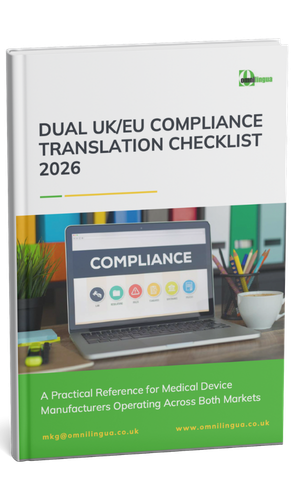
Download Your Free Dual Compliance Translation Checklist
To help you audit your current documentation and translation approach against both frameworks, we’ve produced a practical checklist covering the key divergence points between UK MDR and EU MDR and what each means for your multilingual documentation.
Copyright Omnilingua 2023
Website Design by Inspired Lamb Design